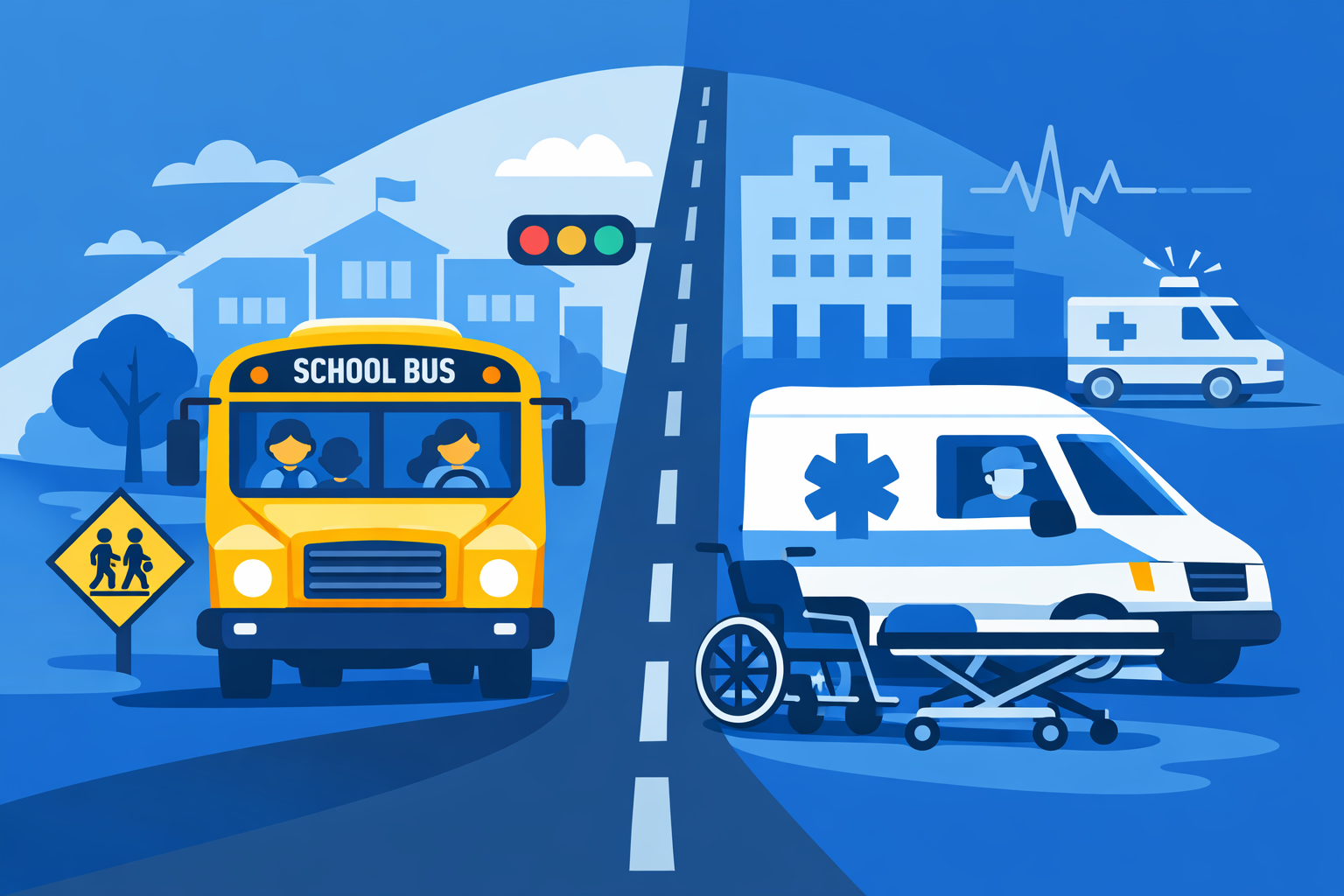
How School and Medical Transportation Are More Alike Than You Think
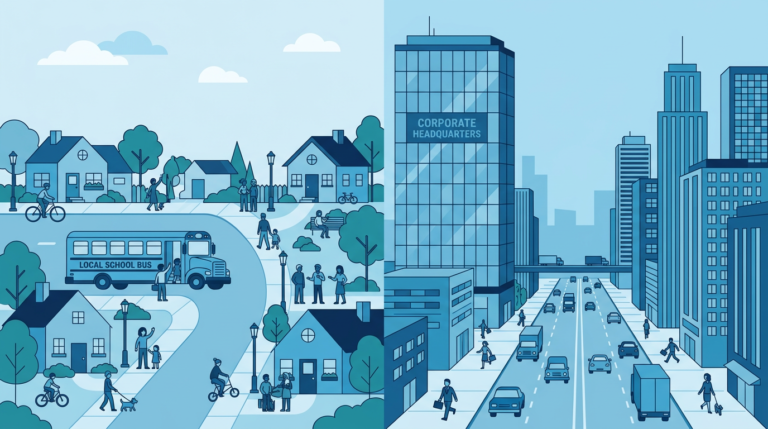
At first glance, school transportation and non-emergency medical transportation seem like two completely different worlds. One serves students and families. The other serves patients and healthcare systems. Different riders. Different destinations. Different stakes.
But after years of operating in both, I can say this confidently: operationally, these two industries are far more similar than most people realize.
Understanding that overlap is what allows transportation companies to scale responsibly, maintain trust, and deliver reliable service in highly regulated environments. It’s also why I’ve always approached transportation as a single discipline, not a collection of disconnected niches.
If you look closely at real-world transportation operations, the similarities become impossible to ignore.
Safety Is the Non-Negotiable Baseline
In both school transportation and medical transportation, safety isn’t a differentiator – it’s the minimum standard.
When transporting students, you’re responsible for minors. When transporting patients, you’re responsible for individuals who may be elderly, immunocompromised, or physically vulnerable. In both cases, mistakes are unacceptable.
This is why scaling transportation requires discipline. You can’t grow by cutting corners. You grow by building systems that protect safety as volume increases. That mindset is central to scaling without compromising standards, because safety failures don’t just hurt reputations – they end businesses.
Regulated Environments Demand Strong Operations
Both school transportation and NEMT operate under layers of regulation. Compliance isn’t optional, and it isn’t static.
Driver qualifications, vehicle inspections, training documentation, background checks, routing rules, incident reporting — these aren’t “nice to have.” They are daily operational requirements.
This is where leadership experience in regulated operations matters. Transportation companies don’t succeed because they have the best marketing. They succeed because they can execute consistently under scrutiny. That operational muscle doesn’t appear overnight – it’s built through experience, process, and accountability.
Scheduling Is the Real Battlefield
Most people underestimate how difficult it is to schedule transportation.
School transportation revolves around bell times, special education routes, weather disruptions, and daily consistency. NEMT revolves around appointment windows, recurring rides, eligibility constraints, and the real human consequences of missing a ride.
In both cases, scheduling is not just logistics – it’s risk management.
This is where firsthand exposure to real-world operational pain points changes how you think about systems. When dispatchers are overloaded, errors multiply. When schedules break, trust erodes. And when systems aren’t designed for real conditions, people end up filling gaps manually – which doesn’t scale.
Teams Make or Break Both Models
No transportation operation succeeds without the right people.
Drivers, dispatchers, supervisors, and support staff are the backbone of both school and medical transportation. The job is demanding, repetitive, and unforgiving of shortcuts. That’s why hiring for mindset matters more than hiring for resumes.
Building reliable service means building reliable teams – people who understand that consistency matters more than speed, and accountability matters more than convenience. When teams internalize that responsibility, quality becomes cultural instead of enforced.
Why This Perspective Matters
Treating school transportation and medical transportation as separate worlds creates blind spots. Treating them as variations of the same operational discipline creates leverage.
The same principles apply across both:
- Safety-first decision-making
- Process-driven execution
- Compliance as a system, not a checklist
- Technology informed by real operations
- Teams built on trust and accountability
This perspective is exactly why I’ve always approached transportation holistically. The problems change. The riders change. But the responsibility stays the same.
If you want to see how these principles come together in practice, you can learn more about my work in transportation and how these operations are structured for long-term reliability and growth.
Final Thought
Different riders. Different missions. The same obligation.
Transportation only works when it’s built by people who understand what’s at stake — and who design systems that respect it. When you see school and medical transportation through that lens, the similarities aren’t surprising at all. They’re foundational.
Sources & Further Reading
- National Highway Traffic Safety Administration (NHTSA) – School Transportation Safety
https://www.nhtsa.gov/road-safety/school-bus-safety - Centers for Medicare & Medicaid Services (CMS) – Non-Emergency Medical Transportation
https://www.medicaid.gov/medicaid/benefits/non-emergency-medical-transportation/index.html - Federal Motor Carrier Safety Administration (FMCSA) – Driver Qualification Standards
https://www.fmcsa.dot.gov/regulations/driver-qualifications - National Association for Pupil Transportation (NAPT) – Safety & Operations
https://www.napt.org/resources/safety/ - Transportation Research Board (TRB) – Transit Operations & Human Factors
https://www.trb.org/Main/Blurbs/175169.aspx